


Introduction
Wiring a 3 way switch wiring diagram with power at light may sound complicated. But it is a common electrical configuration that DIYers can learn with a clear, step-by-step guide.
This wiring setup allows you to control a light from two different locations. When the power enters the light fixture instead of the switch, it can be a bit tricky. But do not worry.
In this guide, we will break down the entire process in a simple and approachable way. You will also learn about ignition switch wiring diagram, 4 way switch wiring diagram, and 3 way switch wiring diagram power at light variations.
Let us dive in.
What Is a 3-Way Switch and How Does It Work?
Before you start wiring, it is essential to understand what a 3-way switch is.
A 3-way switch is a special type of switch that allows you to control a light from two separate locations. For example, you may want to control a light from both the top and bottom of a staircase, or from either end of a large hallway.
In a 3 way switch wiring diagram system, the two switches are connected by traveler wires. These wires allow them to communicate with each other, enabling the light to be controlled from either switch.
This setup uses a third terminal called the common terminal. It connects to either the live wire from the power source or the wire leading to the light fixture.
Understanding the 3 way switch wiring diagram is the first step to mastering this configuration.
Why Choose Power at Light Wiring Setup?
The power at light wiring configuration is commonly used in homes for various reasons. Typically, electrical power comes into the switch box. But in some cases, it is preferable to bring the power directly to the light fixture.
This setup might seem unusual, but it offers several benefits:
Cleaner Switch Boxes: By feeding power directly into the light fixture, you only need to manage the switches and the wiring between them. This eliminates unnecessary connections in the switch box.
Ideal for Long Runs: If it is difficult to route the power to the switch box due to space or other constraints, wiring power at the light can be a convenient and efficient solution.
This configuration is clearly explained in any 3 way switch wiring diagram power at light guide.
Tools and Materials You Will Need
Before you begin wiring, make sure you have the correct tools and materials on hand.
| Tool/Material | Purpose |
|---|---|
| Screwdrivers (flathead and Phillips) | Tightening screws |
| Wire strippers | Removing insulation |
| Voltage tester | Confirming power is off |
| Two 3-way switches | Main components |
| 14/3 NM cable | Traveler wire connections |
| Wire nuts | Securing connections |
| Electrical box | Mounting switches |
| Grounding materials | Safety |
Having these ready will make following the 3 way switch wiring diagram much easier.
Step 1: Turn Off Power and Confirm the Circuit
Safety is the first step in any electrical project.
Turn off the power: Locate the circuit breaker for the light fixture and flip it to the OFF position.
Test the power: Use a voltage tester to confirm that no electricity is flowing to the fixture or the switch.
Tip: Always double-check that the power is off before proceeding. This applies to any ignition switch wiring diagram or 4 way switch wiring diagram project as well.
Step 2: Preparing the Wires for Wiring
Once the power is off, the next step is preparing the wires.
Strip the wires: Use wire strippers to remove about ¾ inch of insulation from the ends of each wire.
Understand wire color codes:
| Wire Color | Function |
|---|---|
| Black | Hot wires (carry current) |
| White | Neutral wires (complete circuit) |
| Red | Traveler wires (3-way setup) |
| Bare copper or green | Ground wire (safety) |
These color codes are standard in every 3 way switch wiring diagram.
Step 3: Wiring the First 3-Way Switch
The first switch is the starting point for the circuit.
Connect the common terminal: Attach the common terminal of the first switch to the hot (black) wire that comes from the light fixture.
Attach the traveler wires: Connect the two traveler wires to the two remaining terminals on the switch. These wires will carry the signal to the second switch.
Ground the switch: Attach the ground wire to the green grounding screw on the switch.
Refer to your 3 way switch wiring diagram to verify these connections.
Step 4: Wiring the Second 3-Way Switch
Next, it is time to wire the second switch in the circuit.
Connect the traveler wires: Attach the traveler wires to the two terminals of the second 3-way switch.
Connect the common terminal: Attach the common terminal of the second switch to the hot wire that leads to the light fixture.
Ground the switch: Connect the ground wire to the ground screw on the switch.
This process is identical for a 4 way switch wiring diagram when adding a third switch location.
Step 5: Wiring the Light Fixture
Now, let us move to the light fixture, where the power enters the circuit.
Connect the hot wire: From the second switch, connect the hot wire to the light fixture’s hot terminal.
Connect the neutral wire: Attach the neutral wire (white) from the light fixture to the corresponding neutral wire in the circuit.
Ground the light fixture: Connect the ground wire to the grounding terminal on the fixture.
Note: Proper grounding is crucial to avoid electrical hazards. This is true for any ignition switch wiring diagram or lighting circuit.
Step 6: Test Your 3-Way Switch Circuit
With everything connected, it is time to test the system.
Flip the switches: Turn both switches on and off to ensure the light is responding correctly to both switches.
Check for any issues: If the light does not work, double-check all connections. Ensure that the traveler wires are securely connected and that the common terminals are properly wired.
Your 3 way switch wiring diagram power at light should now be functioning perfectly.
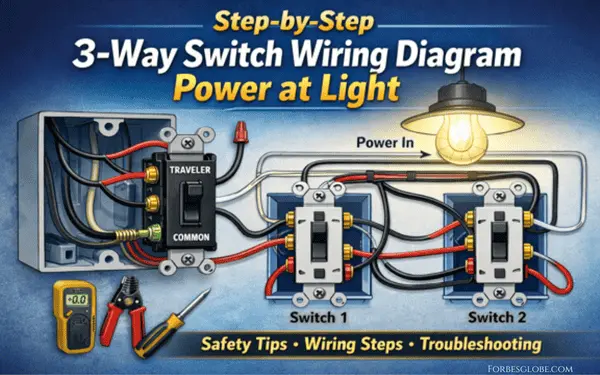
3-Way Switch Wiring Diagram (Text Reference)
Below is a text-based representation of a 3 way switch wiring diagram with power at light:
text
Power Source (Breaker)
        |
        | (Black - Hot)
        |
    [Light Fixture]
        |
        | (Black - Hot to First Switch)
        |
   ┌────┴────┐
   │  Switch 1 │
   │ (3-Way)   │
   └────┬────┘
        |
        | (Traveler wires - Red & Black)
        |
   ┌────┴────┐
   │  Switch 2 │
   │ (3-Way)   │
   └────┬────┘
        |
        | (Black - Hot back to Light)
        |
    [Light Fixture]
This 3 way switch wiring diagram shows how power flows from the source to the light first, then to both switches.
4-Way Switch Wiring Diagram – When to Use It
A 4 way switch wiring diagram is used when you want to control a light from three or more locations.
For example, a long hallway with switches at both ends and one in the middle. Or a large room with three entrances.
How it works:
- Two 3-way switches go at both ends
- One or more 4-way switches go in the middle
- The 4-way switch interrupts the traveler wires
The 4 way switch wiring diagram is an extension of the 3 way switch wiring diagram. Once you understand the 3-way setup, adding a 4-way switch is simple.
Ignition Switch Wiring Diagram – Key Differences
An ignition switch wiring diagram is different from a 3 way switch wiring diagram. Here is why:
| Aspect | 3-Way Switch | Ignition Switch |
|---|---|---|
| Purpose | Control light from 2 locations | Start a vehicle |
| Voltage | 120V AC | 12V DC |
| Terminals | Common + 2 travelers | ACC, ON, START, OFF |
| Traveler wires | Yes | No |
While both are switches, an ignition switch wiring diagram deals with a vehicle’s starting system. Do not confuse it with home lighting circuits.
Troubleshooting Common 3-Way Switch Wiring Problems
Even the best electricians encounter issues. Here are common problems and solutions.
| Problem | Solution |
|---|---|
| Light flickers | Check traveler wire connections. Loose connections cause flickering. |
| Light does not turn on or off | Double-check the common wire. Ensure it connects to the correct hot wire. |
| Switches do not control the light | Ensure traveler wires connect to corresponding terminals on each switch. |
| Only one switch works | One traveler wire may be broken or disconnected. Test both travelers. |
| Light stays on regardless of switches | Common terminal may be wired to a traveler. Swap the wires. |
Always refer to your 3 way switch wiring diagram when troubleshooting.
Electrical Code Compliance and Safety Tips
When wiring any electrical system, follow local building codes.
NEC (National Electrical Code): Ensure all wiring meets NEC standards. This includes proper grounding, wire gauge, and correct color coding.
Safety Practices:
- Always use wire nuts to secure connections
- Ensure no exposed wire that could cause a short circuit
- Turn off power before touching any wires
- Use a voltage tester to confirm power is off
- Work in well-lit areas
- Never touch two wires simultaneously
These safety tips apply to any ignition switch wiring diagram or 4 way switch wiring diagram project.
Frequently Asked Questions (FAQs)
Can I use a regular switch instead of a 3-way switch?
No. A regular switch (single-pole) has only two terminals. It cannot control a light from two locations. You need a 3-way switch for that functionality. Refer to your 3 way switch wiring diagram for correct switch type.
What is the purpose of the traveler wire in a 3-way switch?
The traveler wire allows the two switches to communicate. When you flip one switch, the traveler wires change state, and the light toggles on or off. Every 3 way switch wiring diagram shows two traveler wires.
Do I need to hire an electrician for this project?
If you are confident in your skills and follow all safety protocols, this can be a DIY project. However, if you are unsure, hire a licensed electrician. A 3 way switch wiring diagram power at light can be complex for beginners.
What should I do if the switches are not working after wiring?
Double-check the wiring connections, especially the traveler wires and common terminals. Also, ensure the light fixture is properly connected. Refer to your 3 way switch wiring diagram and start over step by step.
Is it necessary to ground the switch and light fixture?
Yes. Grounding is a critical safety measure. It prevents electrical shock and ensures proper operation of the circuit. Every ignition switch wiring diagram and lighting diagram includes grounding.
What is the difference between a 3-way and 4-way switch?
A 3-way switch works in pairs. A 4-way switch works in between two 3-way switches. Use a 4 way switch wiring diagram when adding a third or fourth switch location.
Can I use 14/2 wire instead of 14/3 for a 3-way switch?
No. You need 14/3 wire because you require two traveler wires plus a neutral. A 3 way switch wiring diagram always shows three conductors between switches.
Where can I find a reliable 3 way switch wiring diagram power at light?
This guide provides a complete 3 way switch wiring diagram power at light. Bookmark it for future reference. You can also check your local electrical code book.
Conclusion
Congratulations. You have completed the step-by-step process of wiring a 3-way switch with power at the light.
You also learned about:
- 3 way switch wiring diagram basics
- Ignition switch wiring diagram differences
- 4 way switch wiring diagram applications
- 3 way switch wiring diagram power at light configuration
Remember always to double-check your work, follow safety protocols, and ensure everything is up to code.
If you ever feel uncertain about any step, consult a licensed electrician to ensure your project is done safely and correctly.
Your action step today: Review your 3 way switch wiring diagram, gather your tools, and start your project. Share this guide with others who may need help.
To read more about click here 5w usb
